About EPI-CAL
Learn more about EPI-CAL and its mission
About Early Psychosis Intervention – California (EPI-CAL)
Approximately 107,000 California residents are estimated to experience a first psychosis episode each year (Radigan et al., 2019). California currently has active programs providing Early Psychosis (EP) services across multiple counties. However, these programs offer different services, follow different treatment models, and measure treatment impact differently.
EPI-CAL was created to help address these issues.
At EPI-CAL, our goals are to support provision of high-quality EP care to all Californians and to promote recovery and better outcomes through a learning health care network approach. EPI-CAL is an initiative that represents a partnership between counties, providers, academic institutions, and the state. Our leadership is actively engaged and providing clinical services in community mental health settings.
EPI-CAL is comprised of multiple components and includes extensive clinical training, technical assistance and consultation, outcomes data collection through a learning health care network, and fidelity assessments and monitoring.
Early Psychosis Intervention – California (EPI-CAL)
EPI-CAL is a collaborative effort across four universities (UC Davis, UC San Francisco, UC San Diego, and Stanford University). We work with counties and their local CSC programs to support the informed development and delivery of high-quality EP care. Our aim is to achieve this through providing ongoing Training and Technical Assistance (TTA) which includes multiple groups of individuals who will collaborate with you for routine consultation, training, fidelity assessments, data management, and evaluation to support evidence-based practice and inform quality improvement plans.
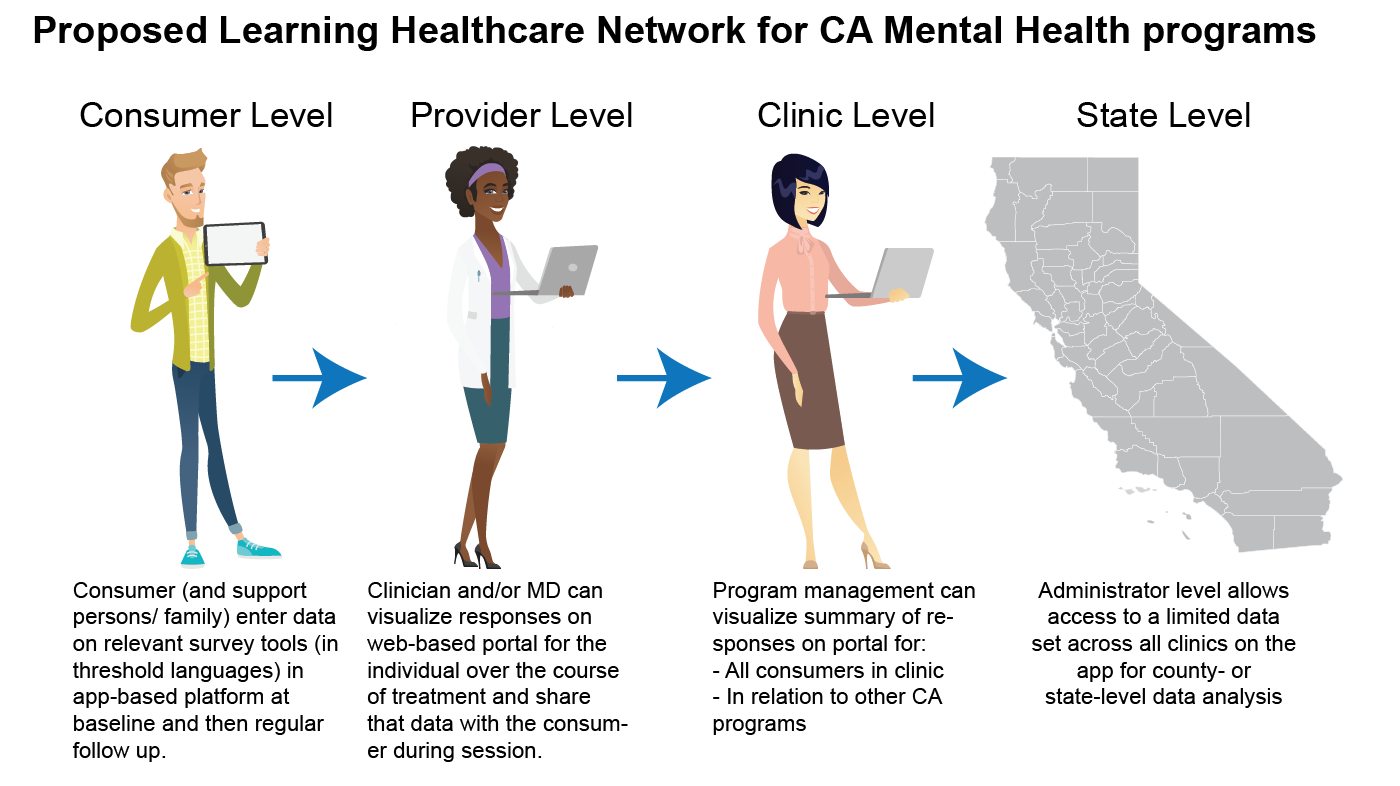
Another central component to the EPI-CAL is facilitating harmonized data collection for use in care and to evaluate outcomes utilizing a Learning Health Care Network approach (LHCN). The technology used by the LHCN will bring the information provided by service users and families back into their care. The providers have access to their service users' data to use as part of their regular appointments with service users and families. This may empower service users to use their own data in care decisions. Program management will have access to all of the survey data from their program. They can compare their whole clinic to the network as a whole. They can use this group data to evaluate the impact of program services and look for areas of strength or for improvement.
EPI-CAL is actively working to ensure that resources meet the needs of a wide range of communities in the state of California including geographic location and population size. Our team has expertise across all CSC programmatic and clinical needs. We are excited for the opportunity to work with counties to meet our overarching goal: equitable access to high quality CSC care for all Californians.
EPI-CAL History
In 2018-2019, five counties (Los Angeles, Orange, San Diego, Solano and Napa) and One Mind committed funding to develop the EPI-CAL Learning Health Care Network (LHCN). In 2019, the UC Davis and UCSF teams secured funding from National Institute of Mental Health through the national EPINET project to expand the network to 2 more counties (San Mateo and Sacramento) and 5 university programs (UCSF, UC Davis, Stanford, UCLA, UCSD). Since that time, Sonoma, Stanislaus, Lake, Kern, Ventura, and a multicounty hub-and-spoke collaborative (Nevada, Mono, Colusa) have chosen to join the LHCN. The LHCN supported the collaborative development of a harmonized outcomes battery based on the preferences of service users, support persons, providers and community partners as well as a data collection application, Beehive, to support statewide collection and evaluation of CSC outcomes. EPI-CAL's LHCN initiated the remote collection of fidelity to CSC best practices using the FEPS-FS.
In 2020, California's AB1315 EPI Plus legislation supported the creation of the EPI-CAL Training and Technical Assistance (TTA) program, which was designed to provide TTA to 5 counties' (as well a hub-and-spoke collaboration) CSC programs. This funding supported a framework for TTA on the core components of CSC for FEP, including county and program consultation for program development; supporting integration of lived experience and family/support person perspectives; incorporating diverse perspectives to ensure we are equitably supporting underserved communities; developing teams to support training and consultation in CSC. We also further developed a remote approach to fidelity assessment using the FEPS-FS.
In 2022, DHCS supported the expansion of our LHCN and TTA to all counties receiving funding from the Mental Health Block Grant 10% Set-aside for Early Psychosis care. With this funding, we expanded our EPI-CAL program to many EP programs and counties across the state. We also developed a modified FEPS-FS fidelity evaluation to assess programs that serve youth at clinical high risk for psychosis. In 2023, we were contracted by the BHSOAC to support the development of an additional 9 programs through the CYBHI Round 5 funding.
In 2025, our team was designated as the DHCS-funded Center of Excellence for Coordinated Specialty Care (CSC) for First Episode Psychosis (FEP) to work with California counties to deliver high-quality CSC. These are areas of continued development, and we are excited to collaborate with current and new partners as part of BH-CONNECT and BHSA to build an EBP for CSC that serves the needs of all Californians. To learn more about the COE, visit the COE landing page.
Impact on California
- We are developing a sustainable learning health care network for California's EP programs.
- In the future, we hope to add additional California counties into the LHCN.
- EPI-CAL will gather high-quality data to understand:
- What is happening now in EP programs
- What is promoting service user recovery (and what is not)
- The needs and priorities of service users, families, and communities
- How data can influence collaborative care decisions in real time
- This project has the potential to create a statewide approach to EP care as EP services are expanding across California
- Participating clinics will be able to participate and learn from a national network of EP programs and data systems (EPINET)
California has the only statewide initiative examining the clinical high risk ("prodromal" population)
Broader Impact (US & Beyond)
- Data from the LHCN will also help us to understand the effectiveness and cost effectiveness of EP care.
- The data will also give us the opportunity to examine a broad group of risk factors, such as risk for homelessness.
- California is the only statewide initiative examining clinical high risk ("prodromal") population. This is one of our unique contributions to the national network.

Beehive is the data collection and visualization software platform that EPI-CAL Early Psychosis (EP) programs will use to incorporate information about a service user's recovery and wellness into their mental health care. Beehive both facilitates the collection of this recovery and wellness information and allows program staff and providers real-time access to it, with the ultimate goal of incorporating this information into care. Service users, family members or support persons, and providers complete surveys every six months throughout the service user's time in the program.
Data Collection: Service users and their self-identified support persons will complete surveys about their experiences. These surveys will ask about symptoms, treatment, and recovery. Individuals will complete surveys on a tablet at the clinic for in-person visits, or on their computer or smartphone if engaging in telehealth. EP providers will also complete surveys in the web application.
Data Visualization: The web application will provide clinic staff and providers with data visualizations of completed surveys. EP providers are encouraged to share these visualizations with service users during appointments. Incorporating this data into care may facilitate conversations regarding treatment goals, encourage shared decision-making, and enhance service users' involvement in their care. Clinic administration can also use this data to monitor treatment outcomes and consider factors which impact recovery.
Beehive is being developed in collaboration with Quorum Technologies, Inc.
Lived Experience
To learn more about EPI-CAL's Lived Experience Integration Team, visit the LEI page.
Past and Present Sponsors
BHSOAC, DHCS, NIMH, One Mind, Los Angeles County, San Diego County, Solano County, Napa County, Orange County, Stanislaus County, Sonoma County, Nevada County, Kern County, Ventura County
Contact
COE: epical.coe@health.ucdavis.edu
General: epical@health.ucdavis.edu
Mission
EPI-CAL was developed by UC Davis, UC San Francisco, UC San Diego, and Stanford University. We provide training, technical assistance, and outcomes data collection to support implementation and sustainability of EP programs across California. Our goals are to support the provision of high-quality EP care to all Californians and to promote recovery.